Composite decking prices in Australia range from around $50 per square metre to over $250 per square metre — a fivefold difference. With that kind of price spread, it’s natural to wonder what you’re actually getting for the extra money, and whether a budget option might do the job just as well.
This guide provides an honest comparison of premium and budget composite decking so you can make the right decision for your project, your climate, and your wallet.
Composite Decking Cost Guide 2026 →
Defining the Tiers
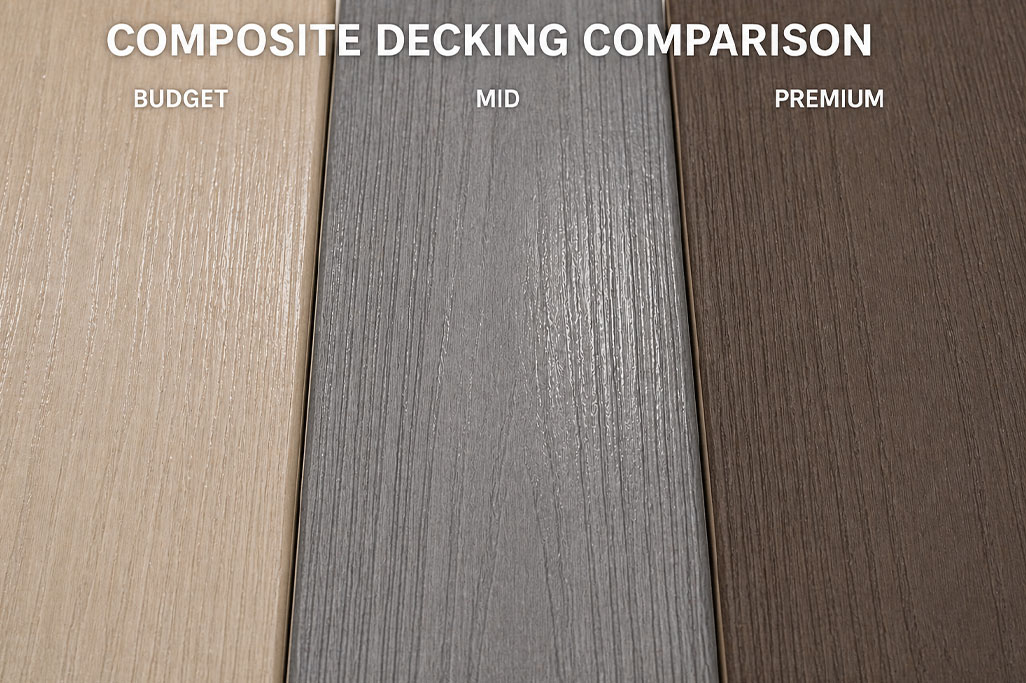
Budget Composite Decking ($50–$120/m²)
Budget composite typically includes uncapped (first-generation) boards and entry-level capped products. These boards offer the basic advantages of composite — termite resistance, no splintering, consistent dimensions — but with compromises on UV protection, stain resistance, and long-term appearance. Warranties are shorter, usually 5–15 years.
Mid-Range Composite Decking ($120–$180/m²)
Mid-range products are fully capped with polymer protection and represent the sweet spot for most residential projects. You get solid UV resistance, good stain protection, realistic timber aesthetics, and 15–20 year warranties. This tier covers the majority of composite decking sold in Australia.
Premium Composite Decking ($180–$250+/m²)
Premium boards feature advanced ASA (Acrylonitrile Styrene Acrylate) dual-layer capping, the most realistic timber grain textures, superior slip resistance, and 25–30 year warranties. These are engineered for maximum longevity and the closest possible resemblance to natural hardwood.
Side-by-Side Comparison
|
Factor |
Budget |
Mid-Range |
Premium |
|
Price per m² |
$70–$120 |
$120–$180 |
$180–$250+ |
|
Cap technology |
None or basic |
Polymer cap |
ASA dual-layer |
|
UV resistance |
Low–moderate |
Good |
Excellent |
|
Scratch resistance |
Low |
Moderate |
High |
|
Stain resistance |
Low |
Good |
Excellent |
|
Timber realism |
Basic |
Good |
Highly realistic |
|
Colour options |
Limited (3–5) |
Moderate (5–8) |
Wide (8–12+) |
|
Warranty |
5–15 years |
15–20 years |
25–30 years |
|
Expected lifespan |
8–15 years |
20–25 years |
30+ years |
Each tier has its place depending on the application, budget, and level of exposure. The goal is to match the product to how the deck will actually be used.
Capped vs Uncapped Composite Decking — What’s the Difference? →
Where You’ll Notice the Difference
Appearance on Day One
Premium boards are noticeably more realistic. The grain patterns are deeper and more varied, the colour blending is more natural, and the surface texture feels closer to real timber. Budget boards tend to look more uniform and ‘plastic’ by comparison. If aesthetics are a priority, the difference is visible from the moment the deck is installed.
Appearance at Year Five
This is where differences become more noticeable over time. Premium ASA-capped boards are designed to retain their appearance far better over time. Mid-range capped boards may show minor colour shift but remain attractive. Budget uncapped boards are more likely to show noticeable colour change over time, may show surface staining, and can develop a chalky or weathered appearance.
Performance Under Stress
Drop a hot coal from the BBQ, drag a heavy pot plant across the surface, or spill red wine at a dinner party — these real-life scenarios expose the performance gap. Premium boards are generally more resistant to everyday wear. Budget boards are far more likely to show permanent marks.
Underfoot Feel
Premium solid-core boards feel dense and substantial underfoot, similar to natural hardwood. Budget hollow-core boards can feel lighter and slightly hollow. This is particularly noticeable in bare feet around pool areas.
The 20-Year Cost Reality
The upfront price difference between budget and premium is significant. But decking is a long-term investment, and the true cost only becomes clear over the life of the deck.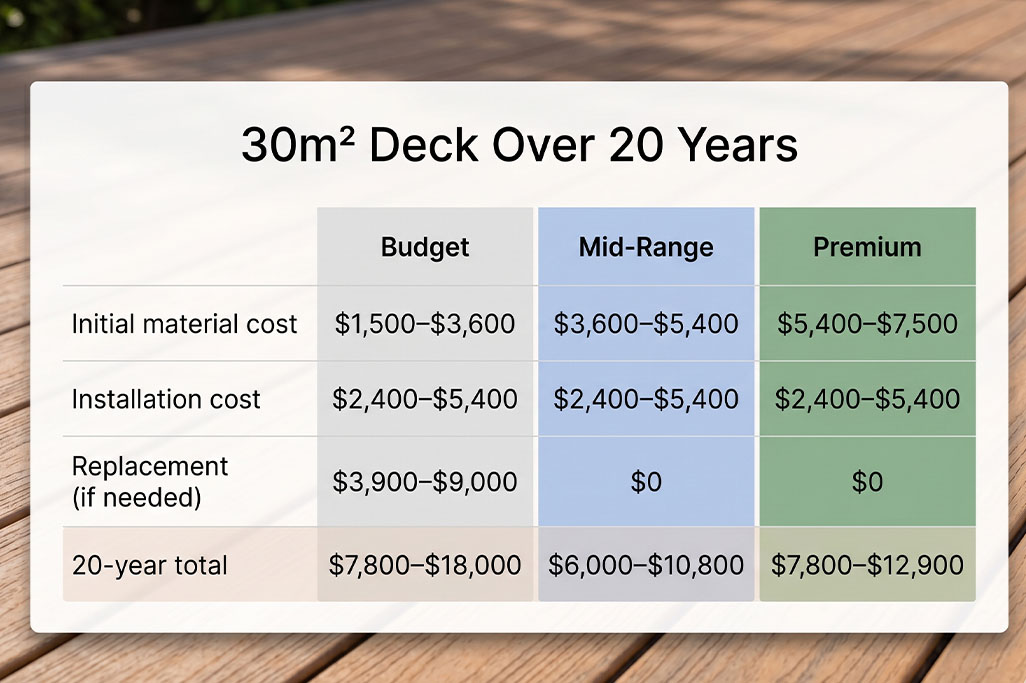
The numbers generally show: mid-range capped composite often ends up being the most cost-effective choice over 20 years, because it avoids the replacement costs of budget products while costing less than premium. Premium makes sense when longevity, aesthetics, and warranty coverage are top priorities.
When Budget Composite Makes Sense
Budget composite isn’t always the wrong choice. It can be appropriate for covered or semi-sheltered areas where UV and moisture exposure are limited, temporary installations or rental properties, areas with minimal foot traffic, projects where you plan to upgrade within 10 years, or utility areas that don’t need to look pristine.
The key is matching the product to the application. A covered entertaining area in Melbourne has very different demands than a poolside deck in full Queensland sun.
When Premium Composite Is Worth It
Premium composite decking delivers the most value in high-UV, full-sun locations, poolside and coastal applications, front-of-house entertaining areas where appearance matters, commercial or high-traffic applications, and projects where you want a long-term solution with minimal ongoing maintenance.
If your deck is the centrepiece of your outdoor living area and you want it to look stunning for decades with low maintenance, premium is the right investment.
Our Recommendation
For most Australian homeowners building an outdoor entertaining deck, mid-range capped composite ($120–$180/m²) hits the sweet spot. You get excellent durability, good looks, solid warranty coverage, and the best long-term value.
If you’re building in a high-exposure environment or want the absolute best aesthetics and longest lifespan, step up to premium ASA-capped boards. The extra cost is modest relative to total project cost and delivers measurable performance gains.
We’d only suggest budget composite for covered or low-exposure applications where its limitations won’t be a problem.