If you are planning a new deck, the first question on your mind is probably: how much will it actually cost? Composite decking in Australia typically ranges from $100 to $250 per square metre for materials alone, depending on the product tier and brand you choose. This guide breaks down the real numbers so you can budget with confidence, compare options, and avoid surprises.
Actual costs will vary depending on site conditions, design complexity, and installer rates, so treat these figures as a general guide rather than a fixed price.
See our full Composite Decking Cost Guide for a broader pricing overview →
Material Cost Per Square Metre by Product Tier
Not all composite decking is priced the same. The cost per square metre varies significantly based on the board’s construction, surface capping, warranty length, and colour technology. Here is how the three main tiers compare in 2026.
| Tier | Price Range (per m²) | Typical Features |
|---|---|---|
| Budget | $100 – $140 | Uncapped or single-sided capping, limited colour range, shorter warranty (10–15 years) |
| Mid-Range | $140 – $190 | Dual-sided capping, wider colour palette, moderate fade and stain resistance, 20–25 year warranty |
| Premium | $190 – $250 | Full four-sided capping, advanced UV stabilisation, realistic timber grain, 25+ year warranty |
Budget boards can work well for back-of-house areas or rental properties where appearance is less critical. Mid-range products hit the sweet spot for most homeowners, offering solid durability without the top-shelf price tag. Premium boards, like the NextGen Titanium range, deliver the closest look and feel to natural hardwood with very low maintenance over their lifespan.
The key takeaway: spending more per square metre upfront usually translates to lower maintenance costs and a longer-lasting deck. A budget board that needs replacing in 15 years may end up costing more overall than a premium board that lasts 25 or more.
Learn more about how composite decking is made and why it matters →
What Affects the Cost Per Square Metre
Several factors push the price per square metre up or down. Understanding these helps you make trade-offs that suit your budget.
Board Construction and Capping
Uncapped boards expose the wood-plastic core to moisture and UV on all sides. They are cheaper to produce but more susceptible to UV damage, staining, and moisture damage over time. Capped boards have a protective polymer shell, and four-sided capping (where every face is sealed) offers the best protection. This is the single biggest factor in price variation between tiers.
Warranty Length
Longer warranties reflect higher manufacturing standards and better raw materials. A 25-year structural and fade warranty costs more to back than a 10-year one, and that confidence is built into the price. Always read the warranty terms carefully; some cover structural integrity only, while others include fade resistance and staining.
Colour Range and Finish
Basic grey and brown boards are the most affordable. If you want realistic timber-grain finishes, variegated colour streaking, or lighter tones that require more advanced UV stabilisers, expect to pay towards the higher end of each tier.
Board Dimensions
Wider and thicker boards generally cost more per square metre. However, wider boards can reduce installation time (fewer boards to lay, fewer fixings), which may offset some of the material premium through lower labour costs.
Composite vs Timber: Cost Per Square Metre Comparison
One of the most common comparisons homeowners make is composite against traditional timber. Here is how the material costs stack up side by side.
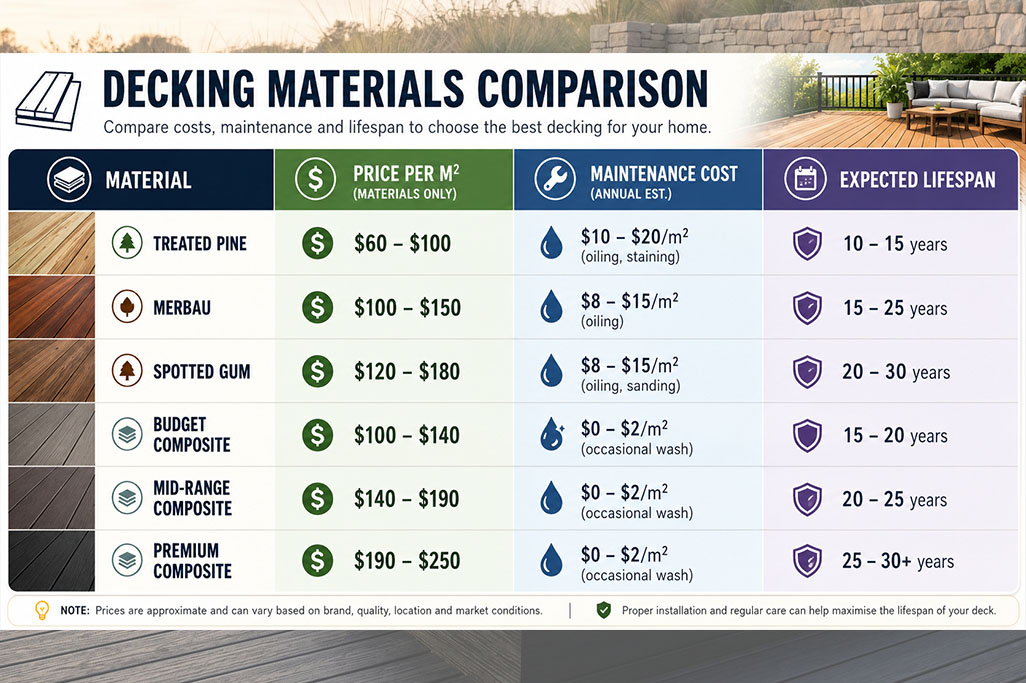
On material cost alone, treated pine is the cheapest option. But factor in annual oiling, staining, sanding, and the shorter replacement cycle, and the total cost of ownership shifts. Over a 25-year period, a mid-range composite deck can often work out more cost-effective than merbau or spotted gum over time.
That is not to say timber is a bad choice. If you love the feel of natural hardwood underfoot and do not mind the upkeep, it remains a beautiful option. The question is whether the long-term savings and low maintenance of composite better suit your lifestyle.
Read our detailed Composite vs Timber Decking comparison →
Total Installed Cost Per Square Metre
Materials are only part of the picture. To get a realistic budget, you need to account for labour, the subframe, fixings, and finishing touches.
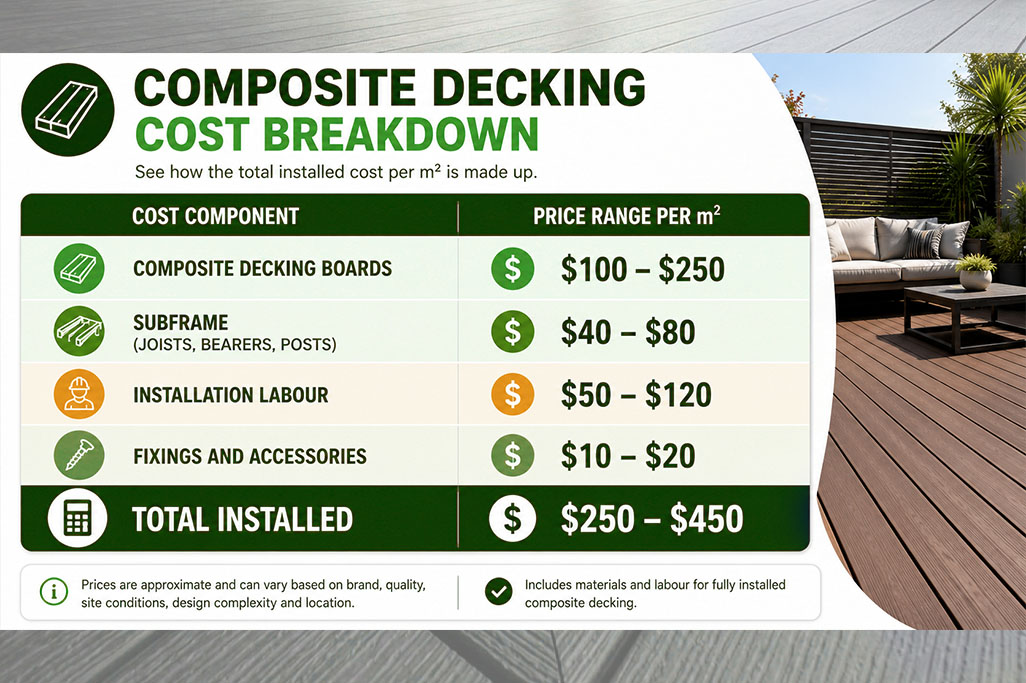
For timber decks, the total installed range sits between $200 and $400 per square metre, depending on the species. Composite comes in slightly higher on the install, but the gap narrows when you factor in the hidden clip systems that many composite brands use. These clips speed up installation (no visible screw holes) and can reduce labour time compared to traditional face-screwing.
Labour rates vary depending on your location, the complexity of the build, and how experienced the installer is. A simple rectangular ground-level deck is far quicker to build than a multi-level design with stairs, curves, or built-in seating.
What to expect during composite decking installation →
See our full breakdown of total deck costs →
Regional Price Variations Across Australia
Where you live in Australia affects your decking costs. Labour rates, transport distances, and local demand all play a role.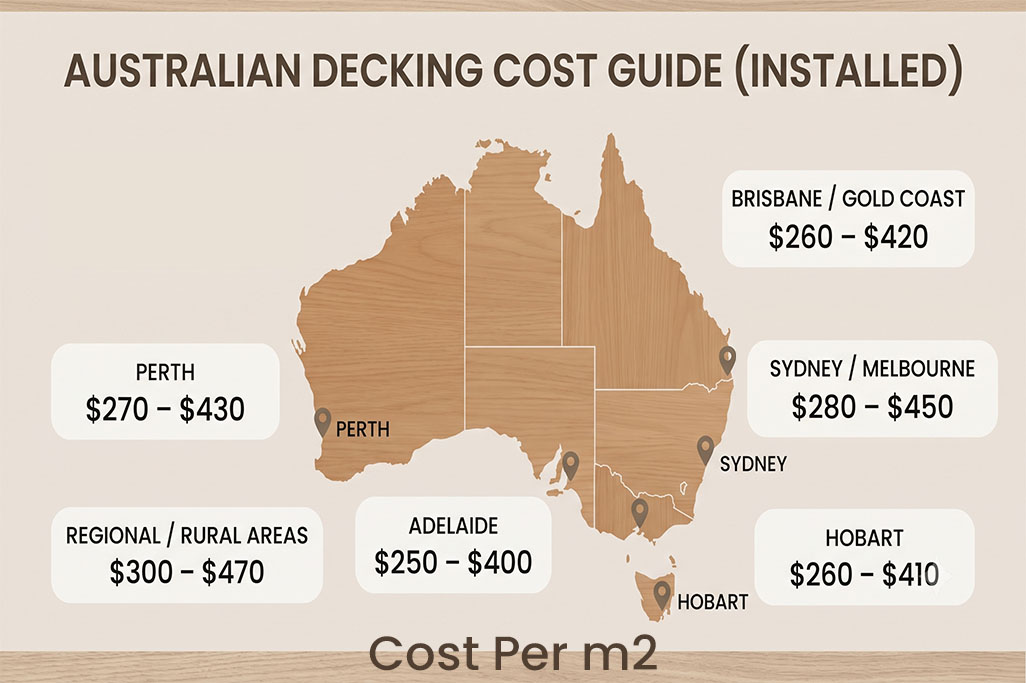
Regional and rural areas often come in at the higher end, not because materials cost more, but because transport fees increase and fewer local installers are available. In metro areas, greater competition among deck builders tends to keep labour rates more competitive.
These are general guides. The best way to get an accurate figure is to request quotes from two or three local installers and compare them line by line.
How to Calculate Your Total Project Cost
Working out your total cost is straightforward once you know the deck area and the product tier you want. Here is a simple formula:
Total Cost = Deck Area (m2) x Installed Cost Per m2
For example, a 30 m2 deck using mid-range composite at an average installed cost of $350/m2 would come to roughly $10,500.
To calculate your deck area, multiply the length by the width. If the shape is irregular, break it into rectangles, calculate each one, and add them together.
A few additional items that can increase the total:
- Stairs: Add $200 to $500 per step, depending on width and materials.
- Balustrades and handrails: Add $150 to $400 per linear metre.
- Built-in seating or planters: Varies widely; get a specific quote.
- Site preparation: If your site needs excavation, retaining walls, or significant levelling, this can add thousands to the project.
Use our Price Calculator to estimate your project cost →
Ways to Reduce Your Cost Per Square Metre
If your quotes are coming in above budget, there are practical ways to bring the numbers down without sacrificing too much on quality.
Choose a Simpler Design
Every angle, curve, and level change adds labour time. A straightforward rectangular deck at ground level is the most cost-effective shape to build. Keeping the design simple can save 15 to 25 per cent on labour.
Opt for Mid-Range Over Premium
The jump from mid-range to premium composite is often $50 to $60 per square metre. If your deck is not in a high-traffic, high-visibility area, a mid-range board may deliver everything you need at a noticeably lower price point.
Do the Subframe Yourself
If you are handy and confident with structural work, building the subframe yourself and hiring a professional to lay the boards can cut costs. Be aware, though, that a poorly built subframe will cause problems down the line, so only take this on if you genuinely have the skills.
Time Your Project Wisely
Deck builders tend to be busiest in spring and early summer. Booking your project for autumn or winter, when demand drops, can sometimes result in more competitive quotes.
Buy Materials Direct
Purchasing your composite boards direct from the manufacturer or an authorised distributor, rather than through a builder’s markup, can save 10 to 20 per cent on material costs. Just make sure your installer is comfortable working with the product you have chosen.