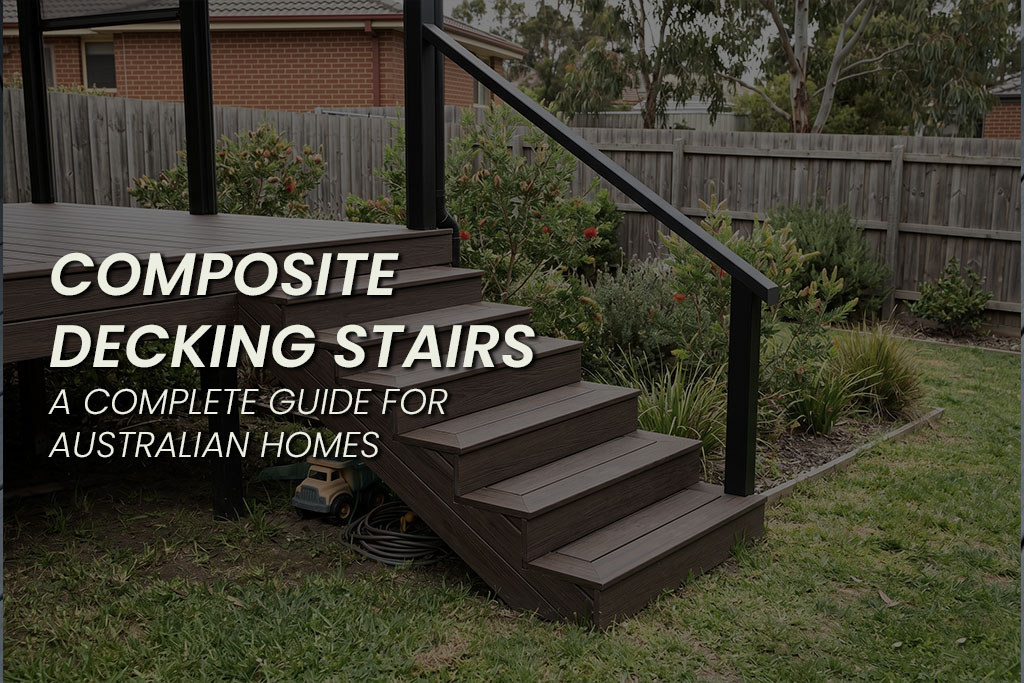
Most raised decks need at least one set of stairs. Whether you are stepping down to the backyard, linking two levels of a split-level home, or connecting a pool deck to a patio, stairs are the transition point that ties the whole project together. Get them wrong and the deck feels incomplete. Get them right and the entire outdoor space flows.
Composite decking is already the go-to choice for deck surfaces across Australia, and the same benefits apply to stair treads. No splinters underfoot, no annual sanding or oiling, consistent colour from the deck surface right down to the bottom step. This guide walks through everything you need to know about composite decking stairs: design options, Australian building code requirements, a step-by-step build overview, costs and tips for a professional finish.
Why Choose Composite for Stairs?
Stairs take more punishment than any other part of a deck. They are walked on, rained on, occasionally dragged over with furniture and shopping bags. Composite handles this well without the ongoing upkeep timber typically requires.
Here is why composite stair treads make sense:
- Slip resistance. Quality composite boards are manufactured with textured surfaces that provide grip, even when wet. This matters on stairs more than anywhere else.
- No splinters.Bare feet and stairs go together in Australian backyards. Composite eliminates the risk of splinters entirely.
- Low maintenance. No oiling, no staining, no sanding. A hose-down or occasional scrub is all that is needed.
- Consistent appearance. Composite stair treads colour-match your deck boards perfectly, giving the whole structure a unified look from top to bottom.
- Durability. Composite does not rot, warp or attract termites. In coastal and humid climates across Australia, that is a significant advantage over hardwood.
Most standard composite decking boards can be used as stair treads, particularly solid or capped profiles designed for higher traffic areas.
How to Install Composite Decking →
Stair Design Options
Before you pick up a saw, you need to settle on a design. The right layout depends on how much height you need to cover, the space available and the look you are going for.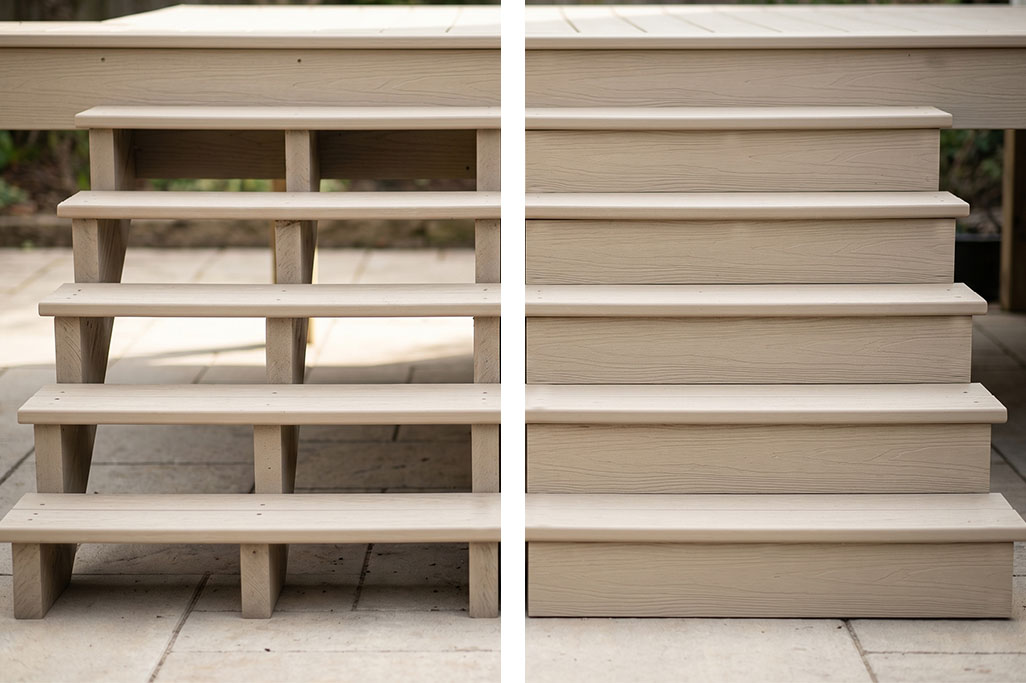
Open Riser vs Closed Riser
- Open riser (no kick boards): A modern, airy look. Light passes through the gaps between treads. Popular for contemporary homes. Note that the NCC has specific rules about open risers, particularly for stairs accessible by children, so check your local requirements.
- Closed riser (with kick boards): A more traditional, solid appearance. Easier to keep debris from collecting underneath the stairs. You can use composite boards or a contrasting material for the risers.
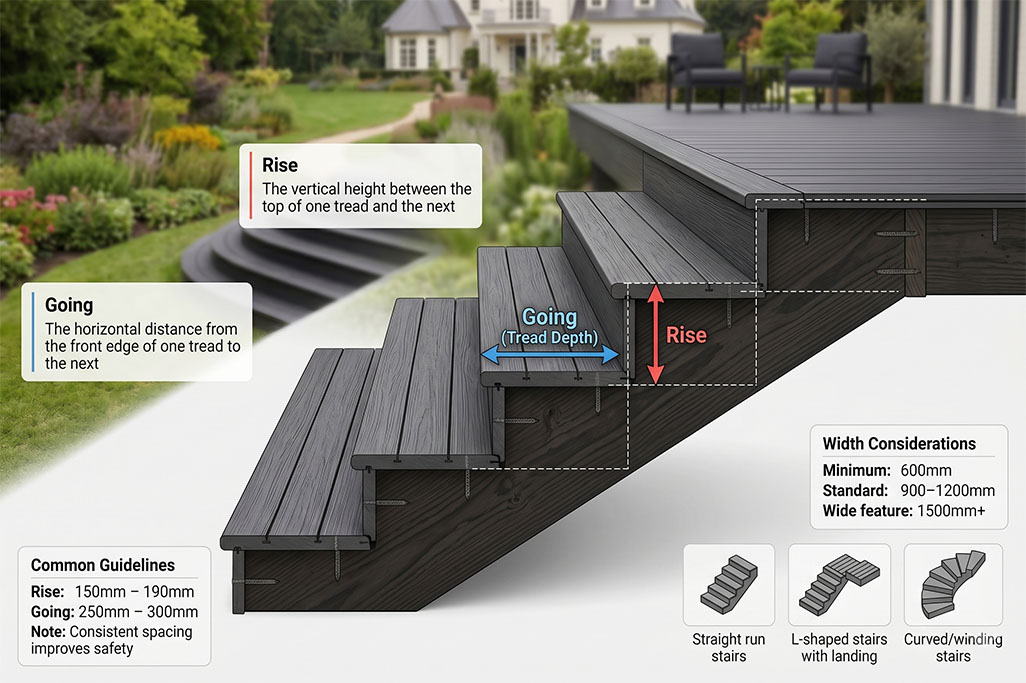
Stair Layouts
- Straight run: The simplest and most common. A single flight from deck to ground. Easiest to build, lowest cost.
- L-shaped (with landing):*A flight that turns 90 degrees at a landing platform. Useful when you need to change direction or the total rise is significant.
- Winding/curved: More complex and visually striking. Requires careful planning and typically professional installation.
Width Considerations
- Minimum width: 600mm (for a service or side access stair).
- Standard residential width: 900mm to 1,200mm. This is comfortable for everyday use and allows two people to pass.
- Wide feature stairs: 1,500mm and above. Often used as a design feature on front-facing decks or entertaining areas
Australian Building Code Requirements
Stairs are a regulated building element in Australia. Whether you are doing a DIY build or hiring a carpenter, the finished stairs must comply with the National Construction Code (NCC), formerly referred to as the BCA. Your local council may have additional requirements, so always check before starting.
Here are the key rules to be aware of:
- Rise (the height of each step):Maximum 190mm per step. All risers in a flight must be uniform, with no more than 5mm variation.
- Going (the depth of each tread): Minimum 240mm. This is the horizontal distance from the front of one tread to the front of the next.
- Rise + Going formula: The NCC specifies that 2R + G should fall between 550mm and 700mm (where R = rise, G = going). A common comfortable combination is 175mm rise with a 275mm going.
- Handrails: Required on at least one side for stairs with more than one rise. Must be graspable with a diameter between 30mm and 65mm, positioned between 865mm and 1,000mm above the stair nosing.
- Balustrade height: Minimum 1,000mm from the stair nosing to the top of the balustrade.
- Slip resistance: Stair treads in external areas should have appropriate slip resistance. Composite boards with a textured or brushed finish are typically designed to meet external slip resistance requirements, but always confirm the rating with your supplier.
- Nosing: The leading edge of each tread should have a rounded or bevelled nosing, not a sharp edge.
Getting these measurements right is critical. Non-compliant stairs can fail inspection, void insurance and create a genuine safety risk.
Composite Decking Cost Guide →
How to Build Composite Deck Stairs: Step-by-Step Overview
This is a general overview of the build process. If you have not built stairs before, read through the entire process before starting, and consider whether this is a job for a professional.
Step 1: Calculate Rise, Going and Number of Steps
Measure the total height from the deck surface to the ground (total rise). Divide by your chosen riser height (staying within the 190mm maximum) to determine the number of steps. Calculate the total going to work out how far the stairs will project from the deck.
Step 2: Build or Install Stringers
Stringers are the structural backbone of any staircase. You have two main options:
- Timber stringers: Cut from treated pine or hardwood. Typically 300mm x 50mm or larger, depending on the span. These are notched to accept the treads.
- Steel stair frame: A pre-fabricated steel frame offers greater strength and longevity. Especially worth considering for wider stairs or where the stringers are exposed to weather and ground moisture.
For most residential stairs, three stringers are recommended: two on the outside edges and one in the centre. The stringers must be securely fixed to the deck frame at the top and to a concrete pad or footing at the base.
Step 3: Install Risers (If Using Closed Riser Design)
If you are building closed riser stairs, fit the riser boards first. Composite boards or a contrasting material can be used. Cut to width and fix to the stringers.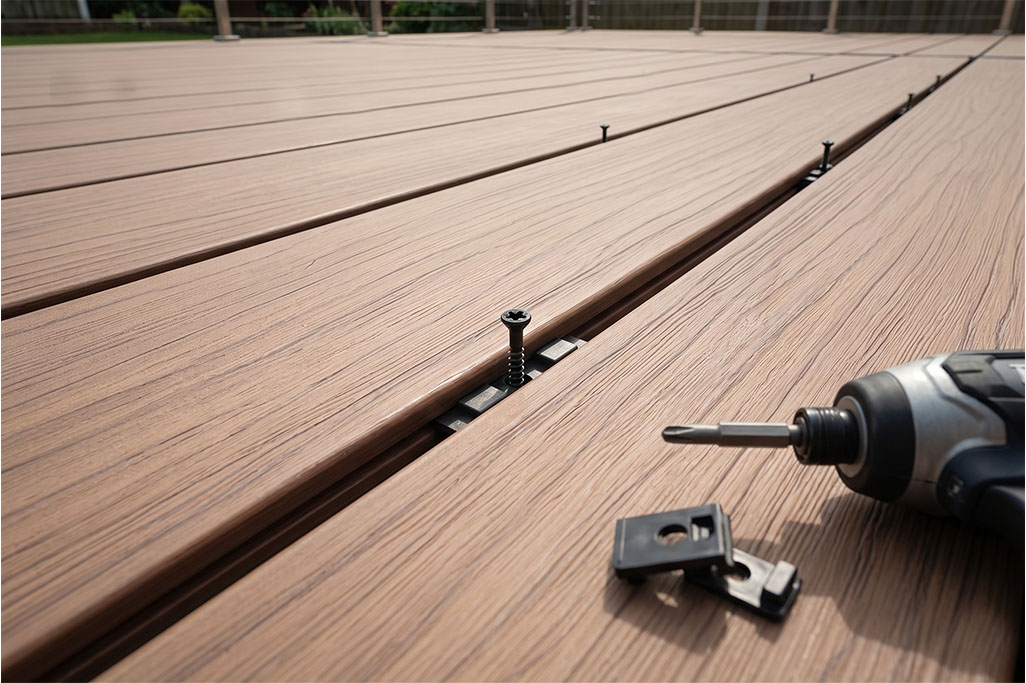
Step 4: Fit Composite Stair Treads
Lay the composite boards across the stringers for each step. Key points:
- Allow for a slight overhang (nosing) at the front edge of each tread, typically 20mm to 25mm.
- Leave the recommended expansion gap between boards (usually 5mm to 8mm, per the manufacturer’s instructions).
- Use hidden fastener clips where the board profile allows. Otherwise, use colour-matched stainless steel screws. Pre-drill to avoid splitting at the edges.
Step 5: Add Nosing and Edging
Finish the front edge of each tread with a composite nosing strip or bullnose edging. This gives a clean, rounded profile that is comfortable underfoot and compliant with NCC requirements.
Step 6: Install Handrails and Balustrade
Fit handrails and any required balustrade to meet code. Stainless steel wire, glass panels and powder-coated aluminium are all popular choices that pair well with composite decking.
Step 7: Final Check
Run through the code requirements one more time. Check that all treads are level, all risers are uniform and all fixings are secure.
Materials Needed for Composite Stairs
A typical single-flight staircase (4 to 6 steps, 900mm to 1,200mm wide) will require:
- Composite stair treads (same boards as your deck surface)
- Composite nosing or edging strips
- Timber stringers (treated pine or hardwood) or a steel stair frame
- Hidden fastener clips or stainless steel screws
- Joist hangers and structural brackets
- Concrete pad or post footings for the stringer base
- Handrail and balustrade components
Cost of Composite Deck Stairs
Pricing varies depending on the width of the staircase, the number of steps and whether you go with timber or steel stringers. Here is a realistic range for the Australian market:
Item | Cost |
Composite stair treads | $100 – $250 per m² (same rate as decking boards) |
Stair nosing/edging | $15 – $30 per linear metre |
Timber stringers (structural) | $30 – $60 each |
Steel stair frame | $300 – $800 per flight |
Total per flight (installed) | $500 – $2,000 |
*Indicative pricing only. Costs vary based on site conditions, access, design complexity and materials used.
For context, a full composite deck installed in Australia typically runs $250 to $450 per m². Stairs are a relatively small portion of the total project cost but they have a big impact on the finished result.
Composite Decking Price Calculator →
Tips for a Professional Finish
- Colour match everything. Order your stair treads, nosing and edging in the same colour and batch as your deck boards. Even within the same product line, different batches can have slight colour variations.
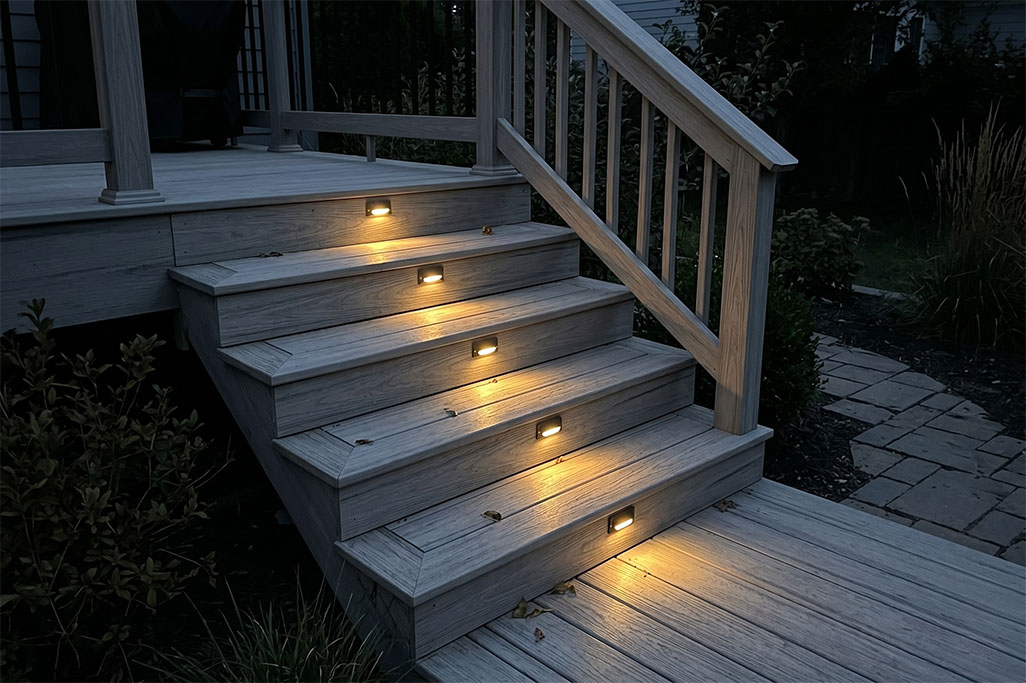
- Add lighting. LED strip lights or recessed step lights along the stair nosing look great and improve safety after dark. Low-voltage options are easy to retrofit.
- Think about drainage. On closed riser stairs, water can pool on treads. A slight fall (1 to 2 degrees) away from the riser helps water run off.
- Use quality fasteners. Stainless steel only. Standard zinc-plated screws will corrode and stain your boards, especially in coastal areas.
- Sand nothing. Composite does not need sanding. If you notice a rough edge after cutting, a fine file or deburring tool is all you need.
DIY vs Hiring a Builder
Composite decking stairs sit in that middle ground between a confident DIY project and a job best left to a professional.
DIY is realistic if:
- You have experience with basic carpentry and working with stringers.
- The staircase is a simple straight run with fewer than six steps.
- You are comfortable interpreting and applying NCC requirements.
- Your council does not require a licensed builder for the work.
Hire a builder if:
- The staircase is L-shaped, winding or more than 1 metre in total rise.
- You are not confident calculating rise and going to code.
- The stairs are attached to a structure that requires a building permit.
- You want a steel frame or custom design.
Either way, getting the structural elements right is non-negotiable. The composite treads are the easy part. The subframe is where the skill (and the safety) lives.