How Much Does a Deck Cost in Australia? (2026 Guide)
Building a deck is one of the best investments you can make in your outdoor living space. It is also one of those projects where the final number on the invoice can surprise you if you have not done your homework.
This guide breaks down every cost involved in building a deck in Australia, from materials and labour to the extras that quietly add up. Whether you are weighing up composite vs timber, planning a small courtyard deck or a large entertainer’s platform, you will find real pricing to work with here.
This article covers the full picture: the total cost of getting a finished deck under your feet.
Quick Answer: What Does a Deck Cost in 2026?
Here is a snapshot of typical installed costs across three common deck sizes. These ranges cover materials, subframe, labour and basic finishing.
Deck Size | Area | Composite (Installed) | Timber (Installed) |
Small | 15 m² | $3,750 – $6,750 | $3,000 – $6,000 |
Medium | 30 m² | $7,500 – $13,500 | $6,000 – $12,000 |
Large | 50 m²+ | $12,500 – $22,500 | $10,000 – $20,000 |
These figures assume a standard ground-level or low-level deck on a flat site. Complex builds, elevated decks, balustrades and site preparation will push costs higher. Keep reading for a full breakdown of what drives those numbers.
What Factors Affect the Cost of Building a Deck?
No two deck projects cost the same. The price you pay depends on a handful of key variables.
- Deck Size
This is the most obvious factor. A larger deck requires more materials, more labour hours and a bigger subframe. Costs scale roughly in proportion to square metreage, though larger decks can sometimes achieve a slightly lower per-square-metre rate because fixed costs (like mobilisation and permits) are spread across more area.
- Material Choice
The decking boards themselves are typically the single biggest line item. Your three main options in Australia are treated pine, hardwood timber (merbau, spotted gum, blackbutt) and composite decking. Each sits at a different price point and carries different long-term maintenance costs.
We cover material pricing in detail below, and you can compare the pros and cons in our Composite vs Timber Decking → guide.
- Deck Height and Access
A ground-level deck built on a flat, accessible site is the most affordable scenario. Once you start going up, costs increase. Elevated decks need deeper posts, more structural steel or timber, engineering certification and often balustrades to meet building codes. Difficult site access (steep blocks, narrow side passages) also adds to labour time.
- Shape and Complexity
A simple rectangular deck is the most cost-effective shape. Curves, multiple levels, angled edges, built-in seating and planter boxes all add both material waste and labour hours.
- Site Preparation
If your site needs clearing, levelling, excavation or drainage work before building can start, factor in an additional cost. Rocky or sloped sites are more expensive to prepare than flat, clear ground.
- Council Permits and Approvals
Most Australian councils require a building permit for decks over a certain height (commonly 800 mm above ground level), and some require them for any attached structure. Permit costs vary by council but typically fall between $200 and $800. Some councils also require engineering drawings, which add to the total.
- Location
Labour rates and material delivery costs vary across Australia. Metro areas generally have more competitive pricing due to builder availability, while regional and remote locations can attract higher transport and labour premiums.
Material Costs: Composite vs Timber
Choosing the right material is a balance between upfront cost, appearance, durability and long-term maintenance. Here is how the main options compare on price alone.
Material Cost Comparison (Supply Only, Per m²)
Deck Size | Area | Composite (Installed) | Timber (Installed) |
Small | 15 m² | $3,750 – $6,750 | $3,000 – $6,000 |
Medium | 30 m² | $7,500 – $13,500 | $6,000 – $12,000 |
Large | 50 m²+ | $12,500 – $22,500 | $10,000 – $20,000 |
Treated pine is the cheapest upfront but demands regular oiling, staining and eventual board replacement. Hardwood timbers like merbau and spotted gum look stunning and last well, but they still need periodic oiling to maintain their colour and prevent greying.
Composite decking sits at a slightly higher entry point than mid-range timber but requires virtually no ongoing maintenance. Over a 20-year period, the total cost of ownership for composite often works out lower than timber once you account for oils, stains, sanding and board replacements.
Use our Price Calculator → to estimate material costs for your specific deck size.
Labour and Installation Costs
Professional deck installation in Australia typically runs between $50 and $120 per square metre for labour alone. That range depends on:
- Complexity of the build.A simple ground-level rectangle is at the lower end. Multi-level, elevated or curved decks push towards the upper end.
- Subframe requirements. The subframe (joists, bearers and posts) is a separate cost from the decking boards, typically $40 to $80 per square metre depending on the material and engineering requirements.
- Your location. Rates vary between cities and regions.
When you get quotes, make sure they clearly separate materials, subframe and labour so you can compare apples with apples.
For more on what professional installation involves, see -Composite Decking Installation →
Total Installed Cost Per m² (Materials + Subframe + Labour)
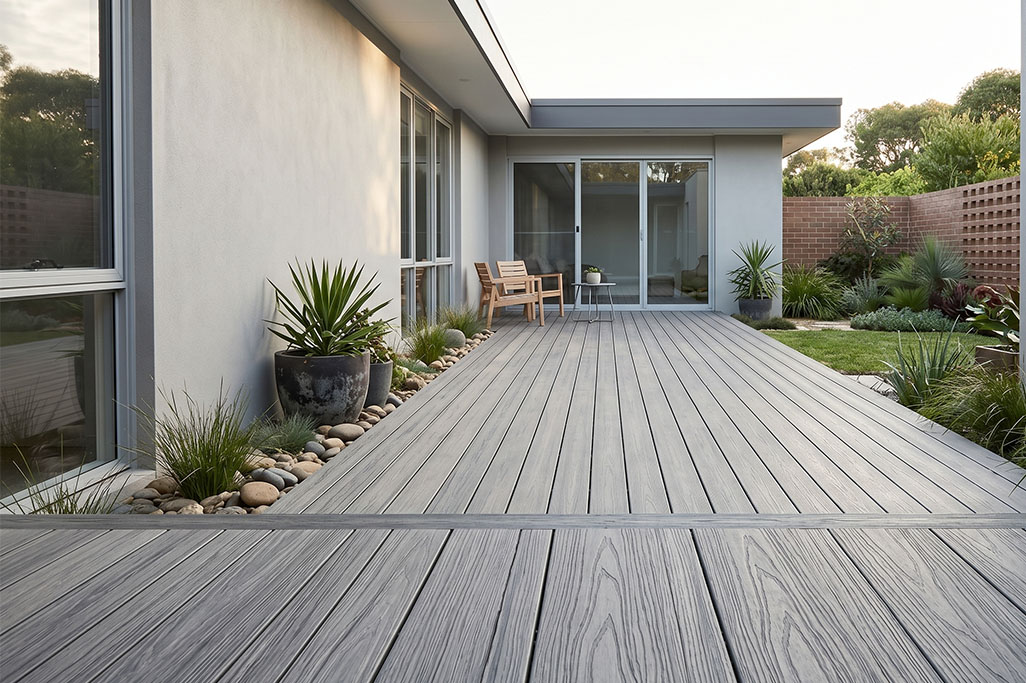
Small Deck: 15 m² (e.g., 3 m x 5 m courtyard deck)
Item | Estimated Cost |
Composite decking materials | $1,500 – $3,750 |
Subframe | $600 – $1,200 |
Labour | $750 – $1,800 |
Council permit | $200 – $500 |
Site prep (basic) | $300 – $800 |
TOTAL | $3,350 – $8,050 |
Medium Deck: 30 m² (e.g., 4 m x 7.5 m entertainer’s deck)
Item | Estimated Cost |
Composite decking materials | $3,000 – $7,500 |
Subframe | $1,200 – $2,400 |
Labour | $1,500 – $3,600 |
Council permit | $200 – $600 |
Site prep | $500 – $1,500 |
Stairs (one flight) | $500 – $1,500 |
TOTAL | $6,900 – $17,100 |
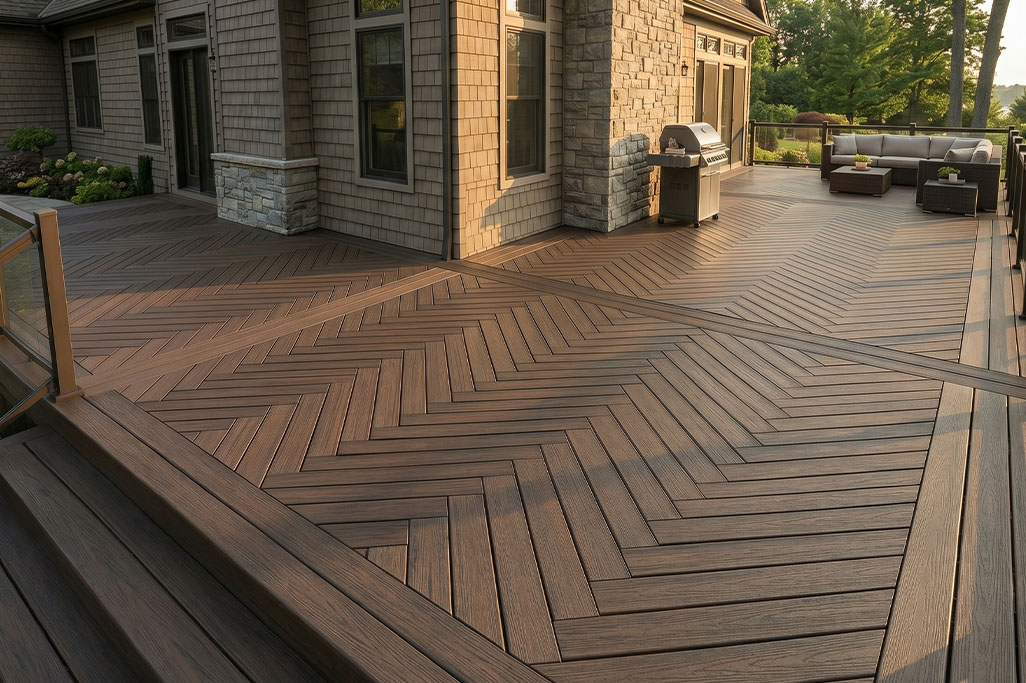
Large Deck: 50 m² (e.g., 5 m x 10 m wraparound deck)
Item | Estimated Cost |
Composite decking materials | $5,000 – $12,500 |
Subframe | $2,000 – $4,000 |
Labour | $2,500 – $6,000 |
Council permit | $300 – $800 |
Site prep | $800 – $2,500 |
Stairs (one flight) | $500 – $2,000 |
Balustrades (10 m) | $1,500 – $4,000 |
Lighting | $500 – $1,500 |
TOTAL | $13,100 – $33,300 |
These are guide ranges. Your actual cost will depend on site conditions, design choices and your location. For a quick estimate tailored to your project, try our
Price Calculator →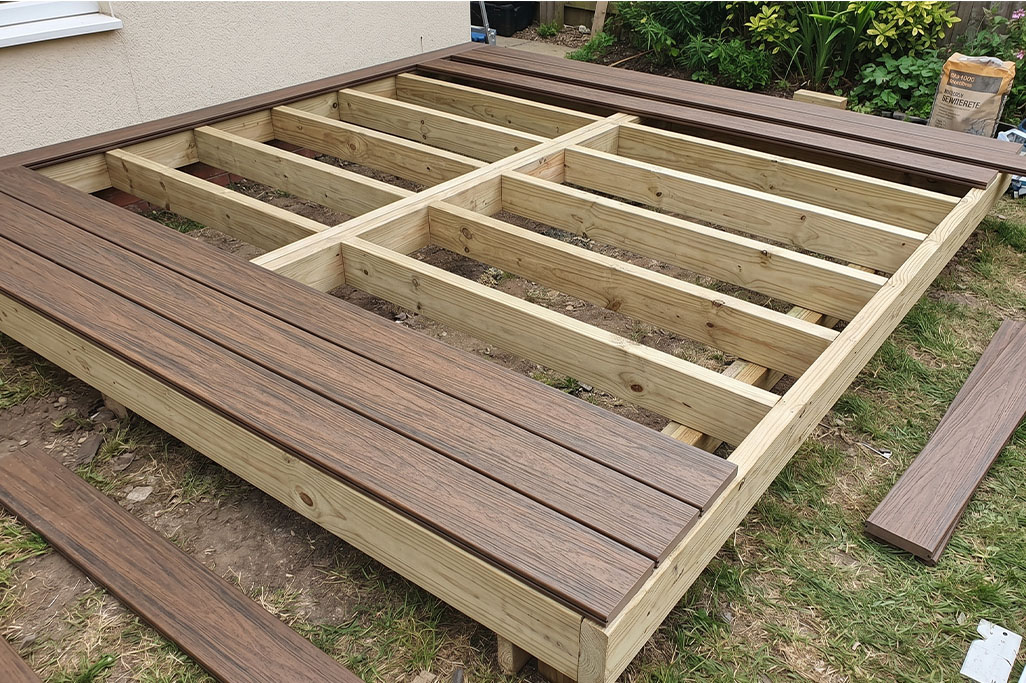
DIY vs Professional Installation
Doing it yourself can save a significant chunk of the budget, primarily the labour component ($50 to $120 per square metre). On a 30 m² deck, that is a saving of $1,500 to $3,600.
However, DIY is not for everyone. Here is how the two approaches compare.
Factor | DIY | Professional |
Labour cost | $0 (your time) | $50 – $120/m² |
Tools | May need to buy/hire | Included |
Build time | 2 – 4 weekends (typical) | 3 – 7 days |
Warranty | Material warranty only | Workmanship + material warranty |
Compliance | You manage permits and code | Builder handles compliance |
Finish quality | Depends on experience | Consistent and professional |
Composite decking is generally more DIY-friendly than timber because it is uniform, does not require sanding or oiling, and uses hidden clip systems that simplify installation. If you are handy and your build is a straightforward ground-level deck, DIY is a realistic option.
For tips on tackling it yourself, check out our
If your deck is elevated, requires engineering, or involves complex shapes, hiring a professional is the safer and smarter path.
How to Save Money on Your Deck Build
A few practical ways to reduce your deck cost without cutting corners:
- Keep the design simple. Rectangular decks with a single level are the most cost-effective. Every curve, angle and level change adds cost.
- Choose your material wisely. Composite has a higher upfront cost, but the near-zero maintenance means you save over the deck’s lifetime. Treated pine is cheap upfront but expensive over time. Pick the option that suits your budget horizon.
- Get multiple quotes. Three quotes minimum. Compare them line by line, not just the bottom number.
- Consider staging the build. Install the deck now and add balustrades, lighting or stairs later when the budget allows.
- Do the site prep yourself. Clearing vegetation, removing old pavers or levelling a small area can save on labour costs if you are willing to put in the sweat equity.
- Time your build. Some builders offer better rates during the quieter winter months when demand drops.
- Buy materials direct. Ordering decking materials directly from the manufacturer can cut out the middleman margin. Brite Decking supplies direct to homeowners across Australia, and you can check current pricing here →
Ready to Plan Your Deck?
The best way to get an accurate cost for your deck is to start with a clear idea of what you want and then get it priced properly. We are here to help with that.
- Request free samples to see and feel the boards before committing
- Use our online price calculator to get a quick estimate
- Talk to our team for advice on materials, design and installation