Why More Australians Are Replacing Timber Decks with Composite Decking
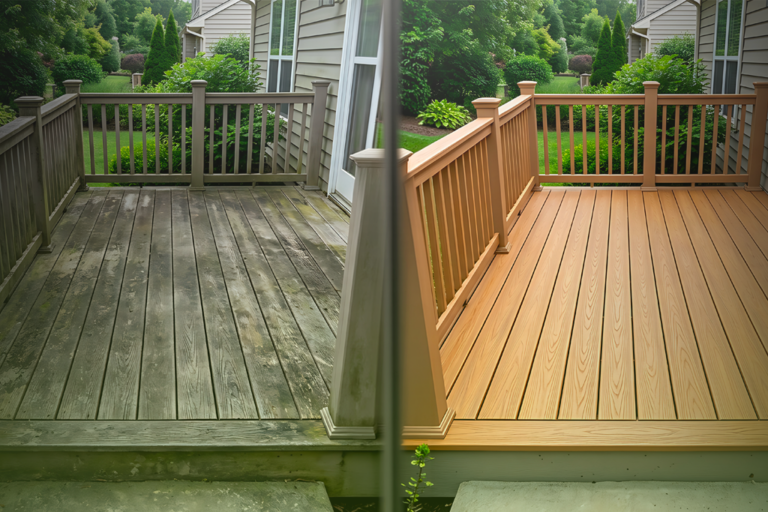
Timber decks have long been a popular feature in Australian homes. They provide warmth, character and a natural outdoor living space. However, after years of exposure to Australia’s harsh climate, many timber decks begin to show their age.
Common problems include:
- Splitting and cracking
- Rot and timber decay
- Loose or protruding screws
- Warping and cupping
- Fading from UV exposure
- Ongoing sanding, staining and oiling
- Slippery surfaces after rain
Rather than rebuilding the entire deck, many homeowners are now choosing a smarter solution—retaining the existing structural frame (where suitable) and replacing only the decking boards with modern composite decking.
This approach can significantly reduce maintenance while giving the deck a completely new appearance.
However, replacing timber decking is not simply a matter of removing old boards and installing new ones.
A successful replacement begins with understanding the existing deck.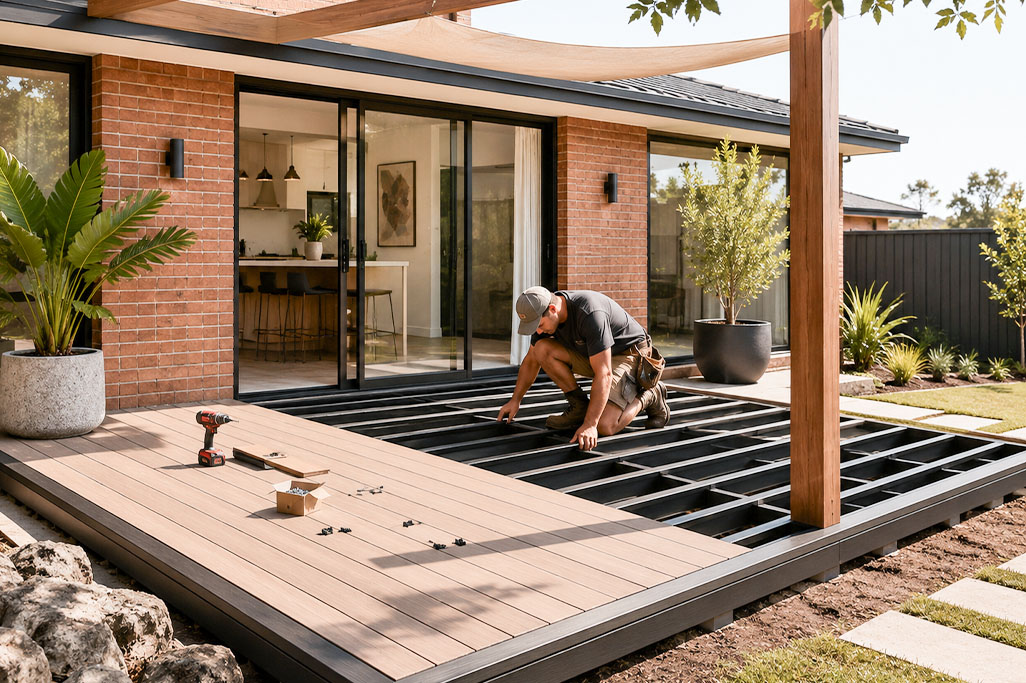
Step 1 – Can the Existing Deck Frame Be Reused?
The first question is not:
“Which composite board should I buy?”
The first question should always be:
“Is my existing frame suitable?”
Many existing decks have perfectly serviceable structural frames.
Others may require repairs, strengthening or complete replacement before new decking boards are installed.
The existing subframe is the foundation of the entire deck. Installing premium composite decking over a deteriorated frame is unlikely to produce a satisfactory long-term outcome.
Timber Frame or Steel Frame?
Most existing decks fall into one of two categories:
Timber Framing
Timber framing remains the most common construction method in Australia.
Before reusing the frame, it should be inspected for:
- Rot
- Moisture damage
- Termite attack
- Splits
- Loose fixings
- Twisted joists
- Excessive movement
Any damaged structural members should be repaired or replaced before installing the new decking.
Steel or Aluminium Framing
Many modern decks use steel or aluminium framing systems.
These generally offer excellent longevity but should still be checked for:
- Corrosion
- Loose brackets
- Movement
- Straightness
- Overall structural condition
Composite decking can be installed on both timber and steel framing systems, provided the correct fixing system is used.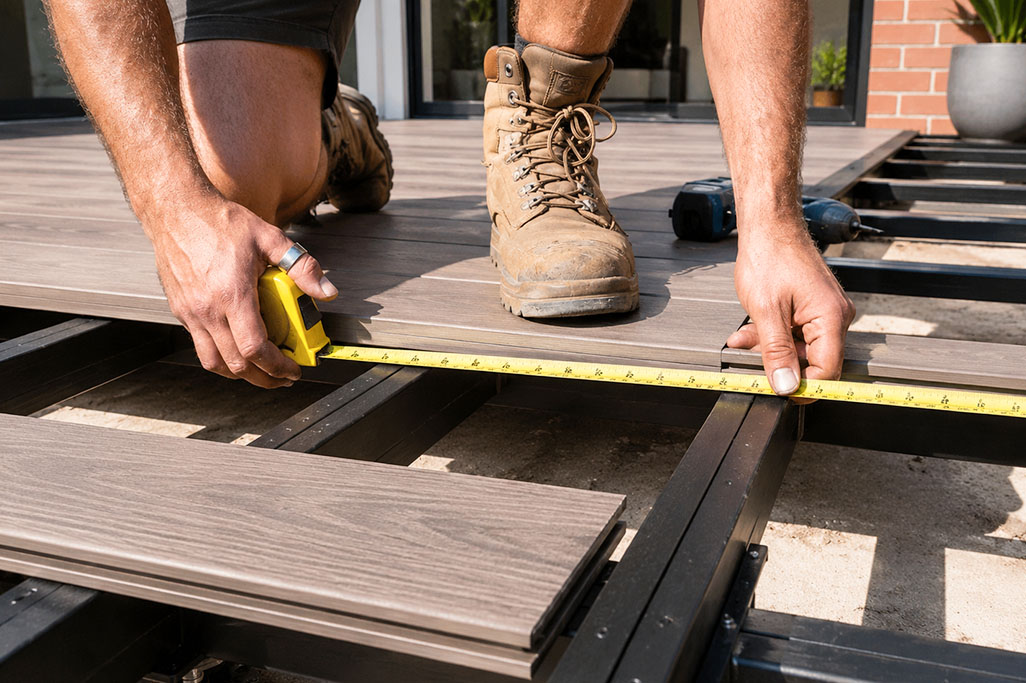
Step 2 – Check the Existing Joist Spacing
One of the most important technical checks is the existing joist spacing (joist centres).
This is one of the first questions the Brite Decking technical team asks customers because it determines whether the existing frame is compatible with the selected decking product.
Older timber decks were often designed for timber boards that could span wider distances than many composite products.
If the joists are spaced too far apart, additional joists may need to be installed before replacing the decking.
This relatively simple modification can dramatically improve the strength, feel and long-term performance of the new deck.
For this reason, we recommend measuring the joist spacing before purchasing materials.
Step 3 – Is the Existing Deck Still Structurally Sound?
While the decking boards are removed, this is the perfect opportunity to inspect the entire frame.
Check for:
- Loose bearers
- Loose joists
- Sagging members
- Water damage
- Inadequate ventilation
- Rusted brackets
- Loose bolts
- Movement in the structure
Many homeowners only discover hidden structural issues once the old timber boards have been removed.
Addressing these issues before installing composite decking is far easier than trying to correct them afterwards.
Step 4 – Consider the Finished Deck Height
One of the most overlooked aspects of replacing decking boards is the finished height of the new deck.
The existing timber boards and the new composite boards may not be the same thickness.
Even small differences can affect:
- Sliding doors
- Entry thresholds
- Pool coping
- Existing patios
- Alfresco areas
- Stair landings
- Drainage falls
Every replacement project should consider how the new decking will align with surrounding surfaces.
Where necessary, there are several methods available to maintain existing levels, depending on the construction of the deck.
This is why selecting the right board profile is just as important as selecting the right colour.
Step 5 – Existing Stairs Need Attention Too
Replacing decking boards on stairs requires additional planning.
Changing the board thickness may alter:
- Riser heights
- Tread depths
- Finished levels
Maintaining consistent stair geometry is important for both appearance and safety.
If stairs are part of the project, they should always be assessed before materials are ordered.
Step 6 – Around Pools? Choose the Right Slip Rating
Pool decks require special consideration.
Water naturally increases the risk of slips, making slip resistance an important factor when selecting decking.
Brite Decking offers composite decking options with higher slip ratings that are well suited for pool surrounds and other wet outdoor areas.
Choosing the appropriate product can improve both safety and long-term performance.
Step 7 – Is Your Home in a Bushfire-Prone Area?
If your property is located in a bushfire-prone area, your decking may need to comply with the relevant Bushfire Attack Level (BAL) requirements.
Not every decking product carries the same BAL rating.
Brite Decking supplies composite decking ranges with BAL compliance suitable for many Australian residential applications.
If you are unsure whether your property is affected, our technical team can help you identify the appropriate product.
Step 8 – Selecting the Right Composite Decking
Every replacement project is unique.
The ideal decking board depends on factors such as:
- Existing joist spacing
- Type of subframe
- Structural condition
- Required finished height
- Pool applications
- Bushfire requirements
- Desired appearance
- Budget
- Expected traffic
- Long-term maintenance expectations
Rather than selecting a board based solely on colour, it is worth considering how the deck will actually be used for many years to come.
 Common Mistakes We See
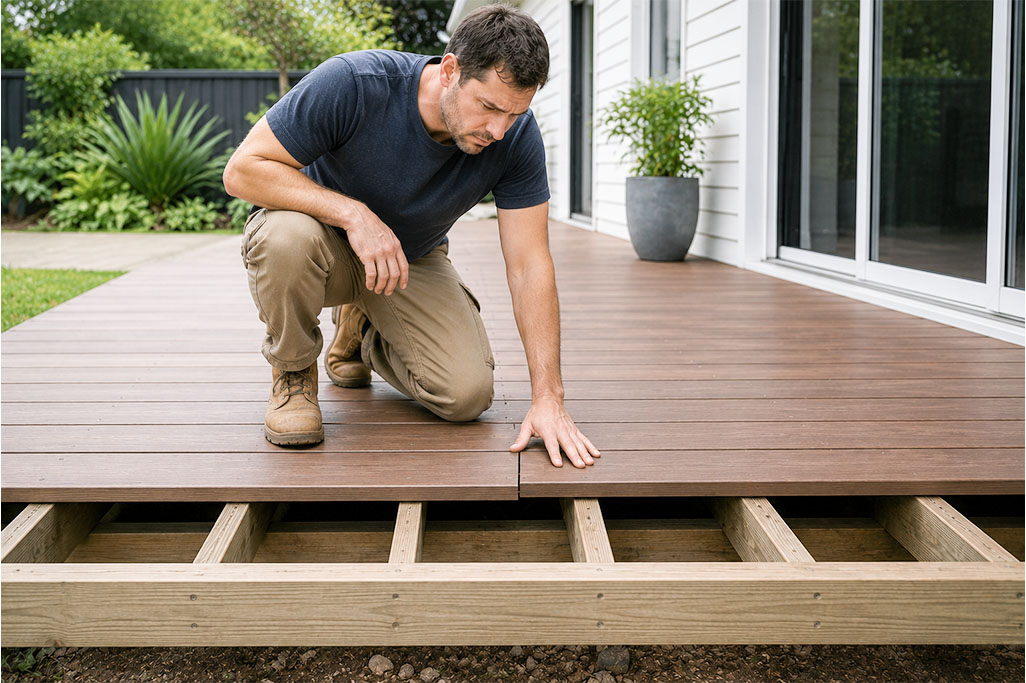 Common Mistakes We See
After assisting many homeowners with replacement projects, we regularly see the same issues arise.
These include:
- Purchasing boards before checking the joist spacing
- Assuming all composite decking products have the same span capability
- Ignoring changes in finished deck height
- Overlooking deteriorated framing
- Choosing a product without considering slip resistance
- Forgetting BAL requirements
- Ordering materials before obtaining technical advice
Many of these issues are easily avoided with a little planning.
Information to Have Ready Before Contacting Brite Decking
To help us provide accurate advice, we recommend gathering the following information before requesting a quotation:
✔ Photos of the existing deck
✔ Photos underneath the deck (if accessible)
✔ Approximate deck dimensions
✔ Existing joist spacing (centre to centre)
✔ Timber or steel frame
✔ Approximate board thickness
✔ Whether the deck is around a pool
✔ Whether the property is in a bushfire-prone area
✔ Any concerns about existing levels or stairs
With this information, our technical team can recommend the most suitable decking solution and advise whether any modifications to the existing frame are likely to be required.
Why Homeowners Choose Composite Decking
Replacing an ageing timber deck with composite decking offers several long-term advantages.
Unlike traditional timber, composite decking requires very little ongoing maintenance. There is no need for regular sanding, staining or oiling, and the boards are designed to resist many of the issues commonly associated with timber, such as rot, splintering and termite damage.
Modern composite decking also provides a consistent finish, a wide choice of contemporary colours and textures, and products suited to a variety of residential applications, including pool surrounds and bushfire-prone areas.
When installed over a properly assessed and prepared frame, composite decking can provide decades of attractive, low-maintenance outdoor living.
Talk to the Brite Decking Technical Team Before You Replace Your Deck
Every replacement project is different.
The existing structure, joist spacing, finished floor levels, stairs, pool surrounds and BAL requirements all influence which decking product is the most suitable.
At Brite Decking, we assist homeowners, builders and installers every day with replacing existing timber decking. Our technical team can assess your project, review photos of your existing deck, recommend the most appropriate composite decking range and provide practical advice before materials are ordered.
If you’re planning to replace your existing timber deck, contact Brite Decking first. A short discussion before you begin can help avoid unnecessary costs, reduce installation issues and ensure your new composite deck delivers the performance and appearance you expect for years to come.