Australian-Made vs Imported Composite Decking: Does Origin Matter?
When comparing composite decking in Australia, it’s common to see brands emphasise where their boards are manufactured. While country of origin may influence perceptions, it is rarely the best indicator of how a deck will actually perform over time.
The factors that matter most are Australian compliance evidence, UV suitability, cap technology, supplier consistency, warranty backing, and local technical support. This guide explains how to compare products based on the criteria that directly affect long-term performance in Australian conditions.
The Australian-Made Composite Decking Market
A small number of composite decking brands manufacture in Australia. These companies typically emphasise local production, Australian jobs, and the ability to control quality on home soil.
Common Claims from Australian-Made Brands
You’ll often see Australian-made brands marketing on the basis of local manufacturing, quality control, supporting Australian jobs, and faster delivery times. These are legitimate selling points, but they don’t automatically translate to a superior product on your deck.
What ‘Australian-Made’ Actually Means
In Australia, the ‘Australian Made’ logo is administered by the Australian Made Campaign (AMCL) and requires that the goods are substantially transformed in Australia with at least 50% of production costs incurred locally. However, not all brands claiming local manufacture carry this certification. Some assemble imported components locally, which is different from manufacturing the core product here. Always check for official certification if local origin matters to you.
The Imported Composite Decking Market
The majority of composite decking sold in Australia is manufactured through established global supply networks across Asia, North America, and Europe. This isn’t inherently a negative. Many leading composite decking manufacturers operate highly specialised large-scale facilities globally, with quality determined by specification control, materials, and testing rather than geography alone.
Why Most Composite Is Imported
Composite decking manufacturing requires significant capital investment in extrusion equipment, raw material supply chains, and quality control infrastructure. The global scale of Chinese and American manufacturers means they can invest more in R&D, produce a wider range of products, and often achieve lower per-unit costs — which benefits the end consumer.
Quality Variation in Imports
This is where due diligence matters most. Imported composite decking ranges from premium, world-class products to low-quality boards that won’t survive Australian conditions. The gap between the best and worst imports is enormous. The key is knowing how to evaluate what you’re getting.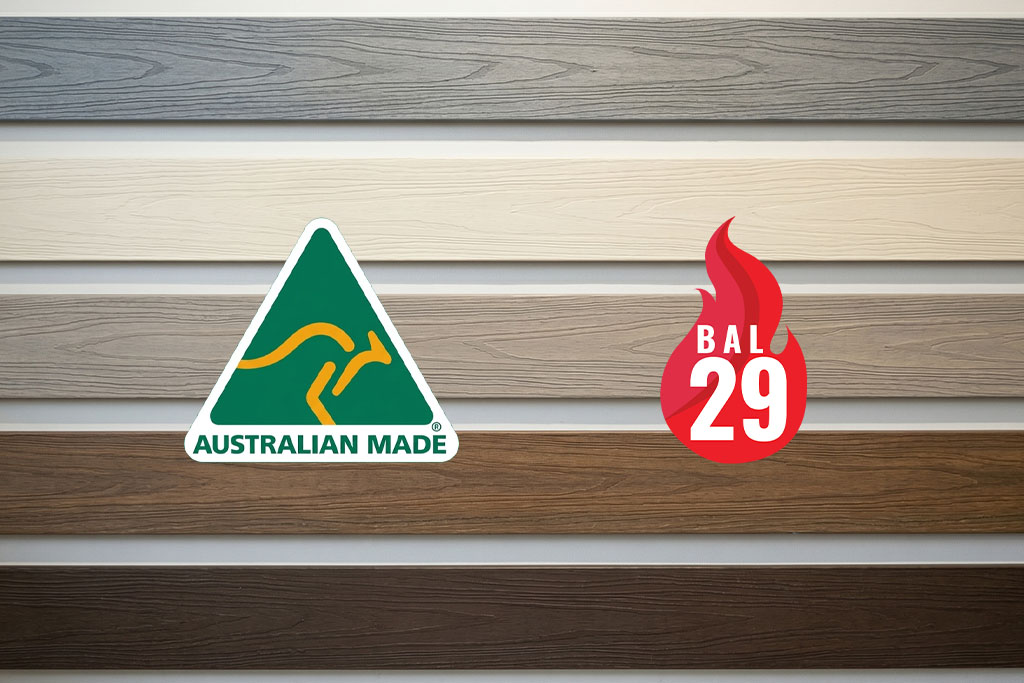
What Actually Determines Quality
Rather than focusing on country of origin, evaluate composite decking on these measurable factors:
1. Australian Certifications and Compliance
For projects requiring formal compliance evidence, always request relevant test reports, NCC suitability documentation, and where applicable, state-specific compliance evidence.
Products with BAL (Bushfire Attack Level) ratings have been tested for fire performance. These certifications apply equally to local and imported products — and some imported brands hold more Australian certifications than some local ones.
Not every composite decking product follows the same compliance pathway, so the level of documentation may vary depending on the board range, installation method, and project requirements. The key is ensuring the selected product is appropriate for the specific application and supported by the right evidence where needed.
2. Warranty Terms and Local Backing
A warranty is only as good as the company behind it. Look for warranties that are backed by an Australian entity with a physical local presence — not just an overseas manufacturer. Key warranty factors include the length of structural and fade warranties, what’s actually covered, whether there’s an Australian company you can claim against, and the claims process and track record.
3. Cap Technology and Materials
The cap layer is the most important factor in long-term performance. Premium ASA (Acrylonitrile Styrene Acrylate) capping provides the best UV and scratch resistance regardless of where it’s manufactured. Ask specifically about the cap material and technology — not just whether the board is capped.
Capped vs Uncapped Composite Decking — Full Guide →
4. Testing and Performance Data
Reputable brands should be able to provide relevant test data where applicable, including slip resistance (AS 4586), fire performance (AS 3959 for BAL ratings), structural performance, and UV/weathering performance. Where available, ask to see current test certificates, BAL documentation, and real Australian project installations so you can compare laboratory performance with real-world outcomes. This data should be from independent, accredited testing laboratories. If a brand can’t provide test certificates, treat their claims with caution — regardless of origin.
5. UV Stabiliser Quality
Australia’s UV index regularly exceeds levels in the US and Europe. Composite decking designed for northern hemisphere markets may not include sufficient UV stabilisation for Australian conditions. Always confirm that the product has been specifically formulated or tested for Australian UV exposure levels. This is particularly important in high-exposure regions such as Queensland, Western Sydney, and coastal NSW, where UV intensity and heat loading can accelerate fade and surface wear.
Cost Comparison
Factor | Australian-Made | Imported |
Typical price range | $120–$220/m² | $80–$250/m² |
Price range explanation | Narrower range, fewer tiers | Wider range, entry to premium |
Delivery timeframe | Typically faster | Variable — depends on stock |
Product range | Usually smaller | Typically wider |
Australian-made products tend to sit in the mid-to-upper price range with less variation. Imported products span a much wider range — from budget boards that undercut local options significantly, through to premium products that match or exceed them in both price and quality.
Composite Decking Cost Guide 2026 →
6. Supplier Consistency and Batch Control
One of the biggest differences between premium and lower-grade composite decking is manufacturing consistency over time.
Boards may appear similar on the surface, but long-term performance depends on stable extrusion profiles, groove tolerances, cap adhesion, colour consistency, and future stock continuity. This becomes especially important if you need matching accessories, additional boards later, or warranty replacements.
A reputable Australian supplier should be able to demonstrate stable production standards and continuity between batches.
7. Why Australian Support Matters
For most homeowners, what matters most after installation is local access to support.
This includes:
- fast sample dispatch
- local warehouse stock
- installation guidance
- state-based consultant support
- technical troubleshooting
- local warranty claims
- replacement board continuity
A well-supported imported board with strong Australian backing can often be a lower-risk choice than a locally manufactured product with limited support infrastructure.
A Balanced Evaluation Checklist
When comparing any composite decking — local or imported — run through this checklist:
Is the warranty backed by an Australian entity you can claim against? Can they provide independent Australian test data for slip, fire, and UV performance? What specific cap technology is used? Is the product formulated for Australian UV conditions? How long has the brand operated in the Australian market? Can you see the product installed on real Australian projects? Are free samples available so you can assess quality firsthand?
Our Position
In our experience across thousands of Australian residential and commercial projects, the best-performing boards are usually those with premium capped surfaces, proven BAL and slip ratings, and consistent local stock continuity — whether manufactured in Australia or through specialist overseas facilities.
Our range is selected based on long-term performance, available compliance evidence, warranty strength, supplier consistency, and overall value. We are also transparent about where our products are manufactured and how they are supported locally.
We won’t recommend a board purely because it is locally made, and we won’t recommend an imported option purely because it is cheaper if it doesn’t meet our quality expectations.
Where projects require formal compliance evidence, our team can help guide customers toward the most suitable product range and provide the relevant documentation available for that application.